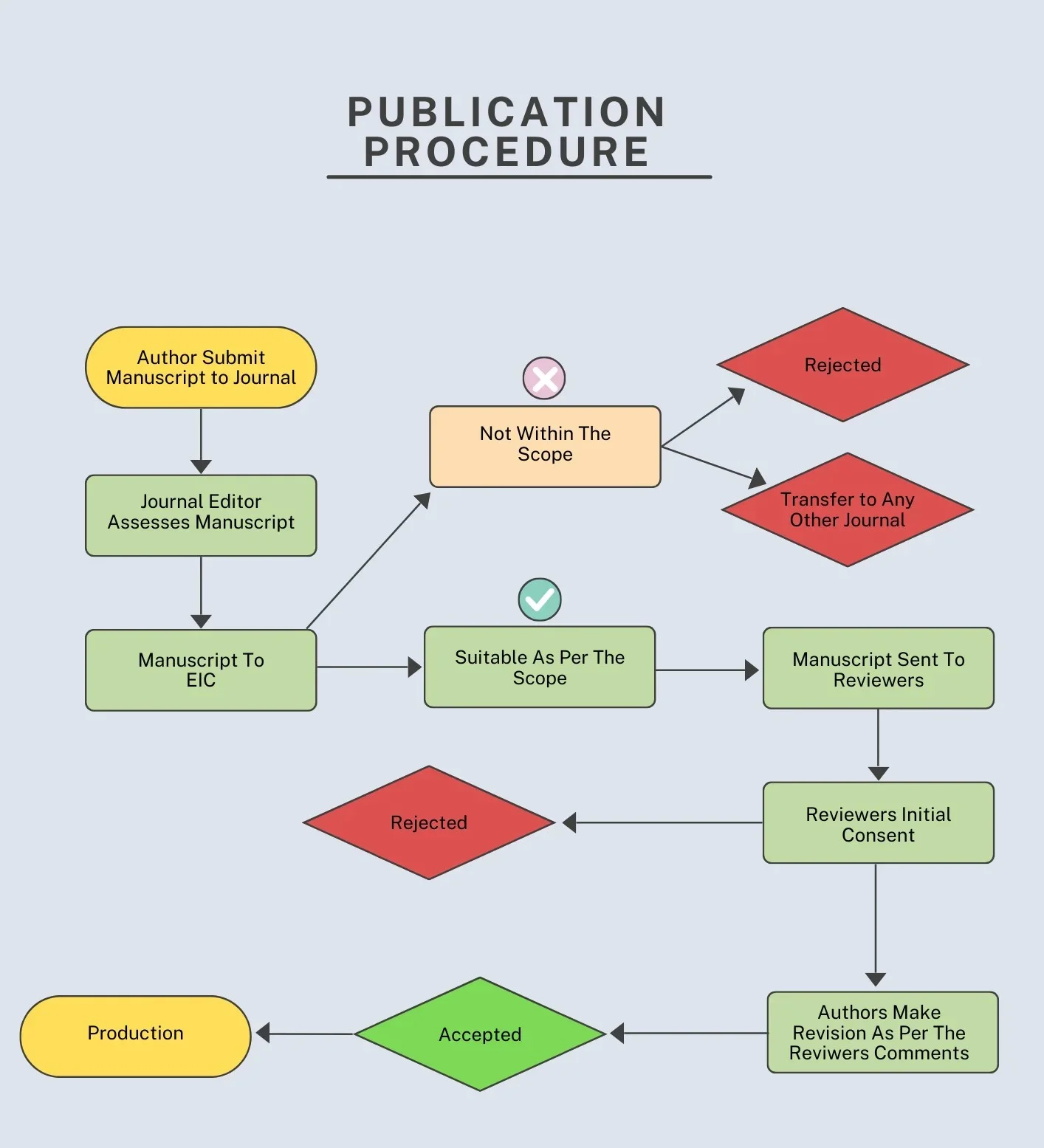
Scholarly Summit aims to provide a transparent and structured publication process that supports research quality, editorial independence, and ethical scholarly communication. Each manuscript is handled according to the relevant journal’s aims and scope, author guidelines, and peer-review policy.
Authors submit manuscripts through the journal’s designated online submission system. Submissions should include the required manuscript files, author information, abstract, keywords, figures, tables, and any supplementary materials, as applicable.
Authors are responsible for ensuring that the manuscript is original, appropriately prepared, and submitted with the required declarations and supporting documents.
The editorial team checks each submission for:
Manuscripts that do not meet the journal’s requirements may be returned for correction or declined before external peer review.
Manuscripts that pass the initial screening proceed to double-blind peer review. Author and reviewer identities are withheld from one another during the review process, subject to the limitations of anonymous review.
Reviewers are selected based on relevant subject expertise and are expected to assess manuscripts objectively, maintain confidentiality, and disclose potential conflicts of interest.
Ordinarily, each research manuscript should be evaluated by at least two independent reviewers, in accordance with the journal’s peer-review policy. Reviewers assess relevant aspects such as originality, methodology, validity of findings, clarity, research ethics, and contribution to the field.
The handling editor considers the reviewers’ reports alongside the manuscript’s scholarly merit, ethical compliance, and suitability for the journal. The editor or other duly authorized editorial decision-maker communicates the decision to the corresponding author.
Possible decisions include:
A revision request does not guarantee acceptance. Editorial decisions are based on scholarly and ethical considerations, not on an author’s ability or willingness to pay publication charges.
When revisions are requested, authors should submit a revised manuscript and a point-by-point response explaining how each reviewer or editor comment has been addressed. Where a suggestion has not been followed, authors should provide a reasoned explanation.
Revised manuscripts may be returned to the original reviewers or assessed by the handling editor, depending on the nature of the revisions and the journal’s procedures.
After the required assessments and revisions are completed, the authorized editor makes the final editorial decision. Authors are informed of the outcome through the journal’s designated communication channel.
Only manuscripts that have received formal acceptance proceed to production.
Accepted manuscripts undergo the journal’s applicable production procedures, which may include copyediting, formatting, reference checks, figure preparation, and preparation of publication proofs.
Authors are asked to review proofs carefully and report necessary corrections within the specified timeframe. Proofreading is intended to identify production errors and should not be used to introduce substantial changes to the accepted manuscript without editorial approval.
Following completion of production and final checks, the article is published in the relevant Scholarly Summit journal according to its publication schedule.
Published articles include appropriate bibliographic information and a DOI where assigned. Copyright and licensing information should be displayed with the article, and publication dates should be recorded.
Articles published under an open-access model are made available in accordance with the applicable journal’s open-access and licensing policies.